

About the condition
Hand contractures are commonly seen in patients with a neurological condition or advanced dementia.
The most frequent cause is due to lack of use, and subsequent shortening/tightening of the muscles and tendons over time.
The following advice and resources were designed for use in care homes, but can be used in other situations, such as caring for a friend or family member in their home.
If you think your resident/ the person you care for may have a hand contracture, this is a checklist of things to look out for:
- spending much of the time with a clenched fist
- unable to fully open hand and stretch out fingers, even with help
- fingernails starting to press into palm of the hand
- hand starting to become odorous and difficult to clean
- expressing pain when you try to open out their hand
If you are a care home worker and suspect a patient has a hand contracture, please refer them to the Care Home Support Team (CHST) for an assessment. In other situations, please raise the issue with a healthcare professional involved in their care.
The best outcomes can be achieved if the hand contracture is identified early on.
Daily hand care
Whilst awaiting an assessment, these are some things to consider.
- Are they in pain during hand hygiene?
- Do they need pain relief prior to personal care? (If nothing is prescribed, do you need to liaise with the GP about a medication review?)
- Could you use something like a rolled-up flannel between fingers and palm (even a baby flannel if the gap is small) to stop the fingers digging into the palm?
It is vital to adequately manage this condition to prevent pressure sores and skin breakdown to the palm and fingers. It's also important to stretch and move the hand as much as tolerated, to prevent further deterioration and pain from stiff joints and tight tendons.
Effective nail care is important to prevent injury and infection. Download 'Resource 12 - Fingernail care' below or visit our advice page.
Carer responsibilities
It is the responsibility of carers/care home staff to monitor the hand condition and ensure all care needs are met.
Hand hygiene principles
Hand hygiene is important as wet/sweaty skin changes the normal skin barrier and can lead to skin breakdown, sores, and infections.
Once a hand contracture is present, movements can be uncomfortable and difficult, therefore it is essential to maintain adequate hand hygiene and there are important principles to consider.
- Consider pain relief prior to hand hygiene and ensure the person has had ‘breakthrough’ pain relief within an appropriate amount of time prior to starting the hand hygiene.
- Your hands must be clean prior to engaging in hand hygiene and gloves should be considered as per protocol.
- Always involve the person and check that they are ready to start.
- Use a bowl of water to soak the hand, but only if the positioning of the hand enables this.
- Be aware the muscles in the arm/wrist may be tight, so use slow, gentle, but firm, movements to allow the hand to be in the best position to clean. Do not force the hand open. A light touch may also be necessary if the person has sensory issues.
- Be aware that touching a person’s hand may cause it to become tighter. Talking to them and drawing their attention away from the hand may help.
- Ensure to clean the palm, between all the fingers, between the webspace of thumb and finger, and back and side of hand as tolerated.
- Check for any skin breakdown as you clean.
- Ensure soap is low pH (acidic) and do not use anything scented.
- The towel should have a lot of absorbency. Consider microfibre towels and or small baby flannels (which are absorbent).
- Keep their nails short to prevent future problems.
- Ideally, the hand must be dry following the wash.
If the hand is very tight or if after the above steps have been taken and the patient is experiencing ongoing odour of the hand, refer to a healthcare professional for advice.
Pain relief
People with hand contractures may experience pain at rest and if force is used to open a hand, e.g. for hand hygiene, this may be painful.
People who have difficulty communicating may struggle to express pain and it may be difficult to assess their pain. The Abbey Pain Scale may be useful for determining a resident’s level of pain and response to pain relief. For those who can express pain verbally, a number pain scoring tool may be useful, e.g. x out of 10.
If the person you care for is experiencing pain from hand contracture(s), consider the following.
- Good communication between nurses/senior carers, carers, and GPs, and full care plan records, is important to make sure that effective care and pain relief are provided.
- Discuss the need for pain relief with their GP, who will decide the level to be used (usually starting with paracetamol as required, then regularly if needed).
- Pain relief may only be needed before any hand hygiene is attempted or all the time, depending on severity.
- If paracetamol is ineffective, the next step may be codeine, morphine, or another suitable alternative on a ‘when required’ or regular basis. The dose or type of medication may need to be adjusted if it does not work or if there are side effects.
- Make sure their pain is reviewed regularly to ensure pain relief is effective and act if it isn’t. Using a pain scale and recording pain levels at different times of the day can be useful (see example of an Abbey Pain Scale on the following page).
- A body map may be helpful if there are multiple areas of pain to assess and treat.
- If pain relief is needed before any hand hygiene, give it at least 30 minutes before and check it is working before starting (an instruction can be added to the prescription and their medication administration record (MAR) to make sure this happens).
- Record the effect of any pain relief on the relevant MAR chart section (see example on p3).
- Check and report any side effects of the medication to the GP, e.g. if morphine is used, drowsiness, confusion, or constipation may occur.
Download 'Resource 3 - Pain relief for hand contractures' from the section below to view an example Abbey Pain Scale and medication recording chart.
Interventions
Ask a healthcare professional for further advice regarding a trial if you feel any of these options may be suitable.
Resting splint
For risk of contractures involving the wrist, or where there is a functional need, a resting splint can help to maintain functional hand position and reduce risk of hand contractures.
Referral to orthotics or hand therapist for custom intervention may be needed.
How to obtain: Special order by a healthcare professional.
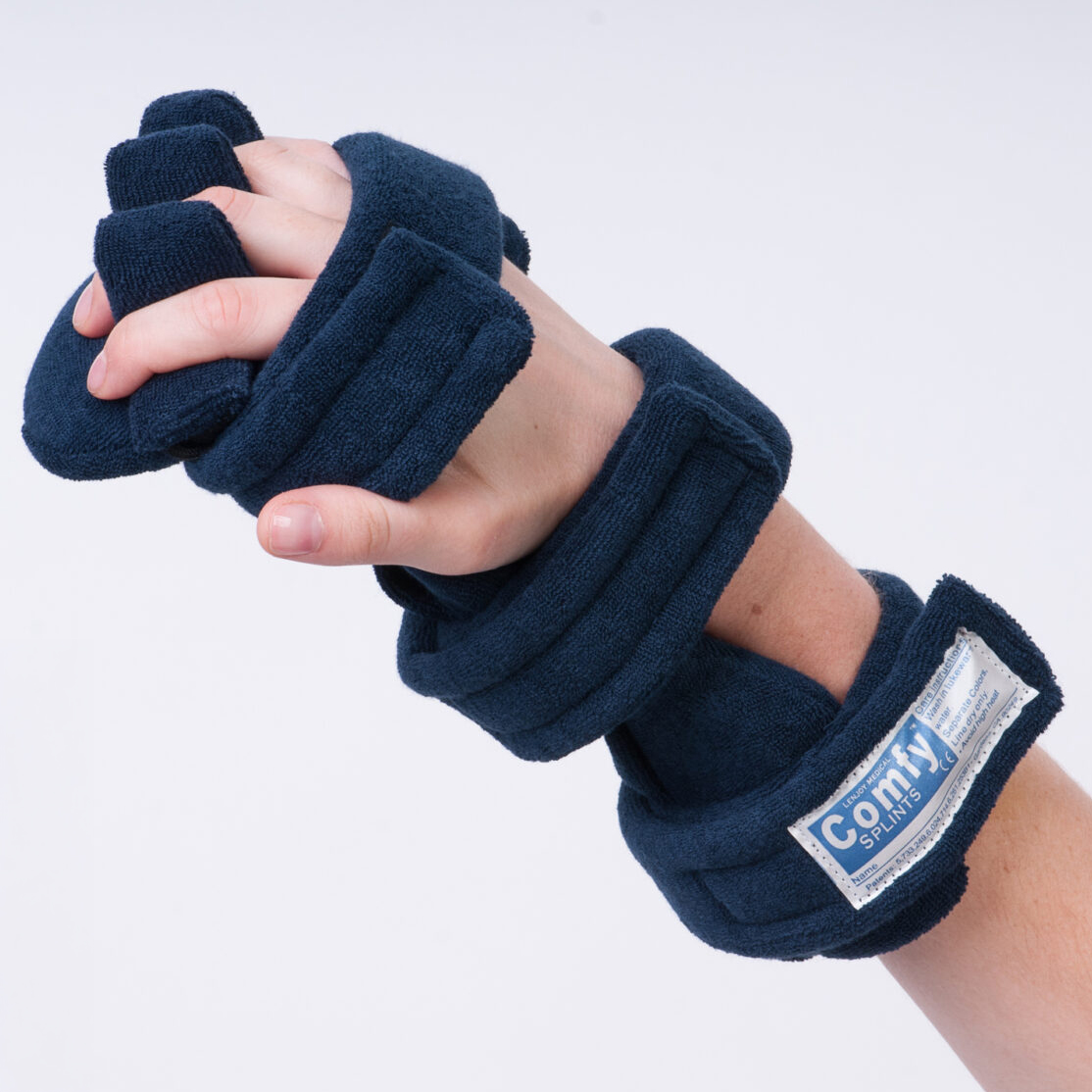
PCM Palm Protector
Can be used on either left or right hand. Use for those who have moderate to severe contractures.
The palm protector provides a unique low stretch therapy to the contracted hand.
- Provides a comfortable cushioned grip with a continuous flow and redistribution of microbeads within the cushion, preventing pressure build up and shear.
- Velcro strap for easy fastening.
- Dimensions 14.5 x 4.5cm.
To gradually build up wearing of splint.
How to obtain: Special order by a healthcare professional.
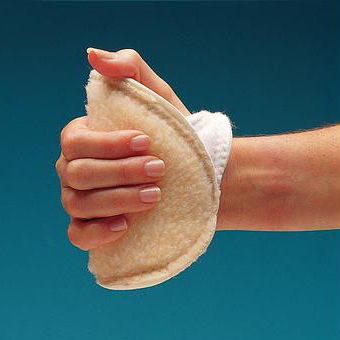
Sheepskin Palm Protector
To be used when hand contracture is severe, with limited range at the MCP and IP joints, but there is good abduction of the thumb, and the aim is to protect the palm.
- Specific to left or right hand.
- Monitor skin on thumb webspace due to stitching and risk of sheer in this area.
- Wash (making sure to dry well) and replace regularly.
- To gradually build up wearing of splint.
How to obtain: The Care Home Support Team (CHST) have a small stock of Rolyan products (pictured) available on request.
DermisPlus Prevent Large Pad and Tape/Strips
Pads to be used where the range is extremely limited, and a palm protector is unsuitable.
Tape can be used instead of a pad when there is a small area to be protected. The tape can be woven between fingers to prevent pressure between fingers.
- Not to be ingested, therefore consider risk assessment for individual.
- Skin must be intact or stop/review.
- Can be cut to size.
- Provides redistribution of pressure.
- To be washed with soapy water and dried daily. Can be used multiple times – discard when shape is altered/compromised.
- Should be issued and monitored by nursing staff.
- Please monitor moisture on the skin and stop if you see signs of redness/ irritation.
- Do not use over-wound dressings.
- Consider the use of barrier film spray if moisture begins to build up.
How to obtain: Initially ordered by a healthcare professional, then via GP prescription when in a care home.
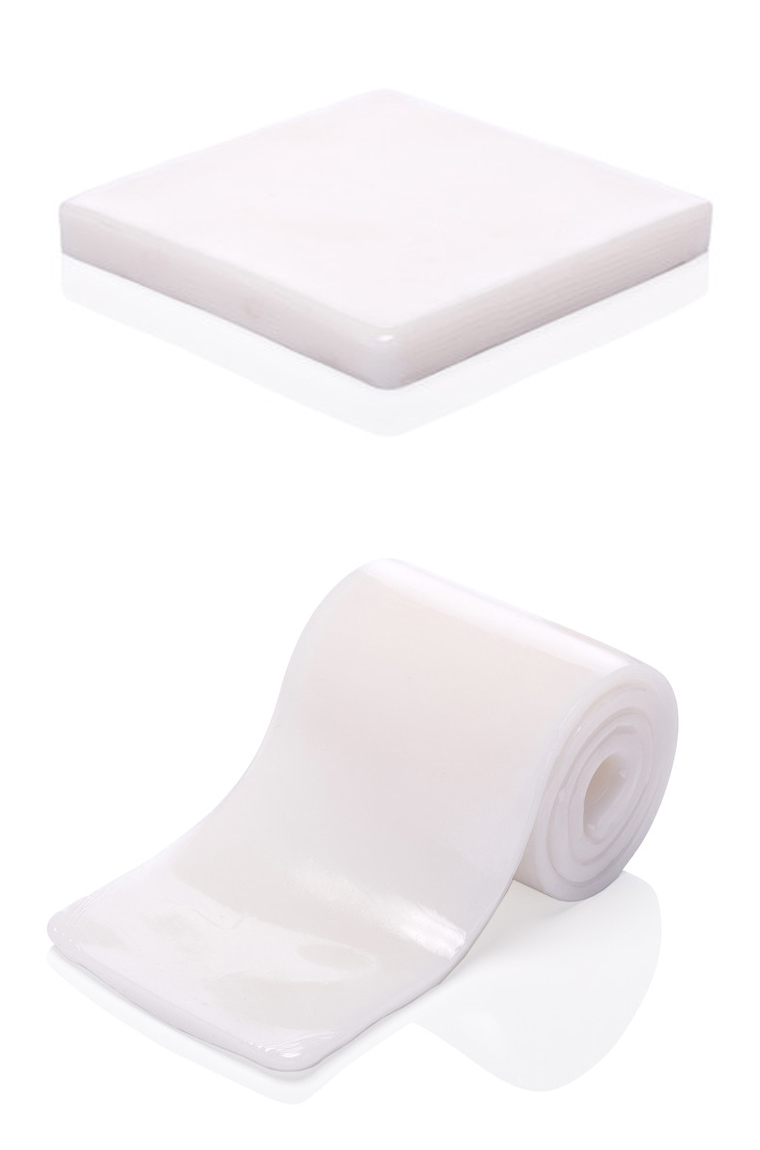
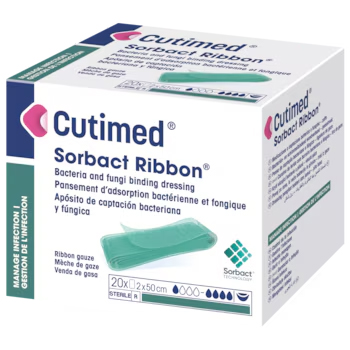
Cutimed Sorbact
For severe contractures where there is a build-up of bacteria/fungal infection, as this product contains antimicrobial treatment and can help reduce bacteria in wounds (and odour).
Does not redistribute pressure.
- Can be used in conjunction with DermisPlus products.
- Comes in a ribbon or a flat large piece.
- Can be used for up to 7 days before being thrown away.
- Apply directly to affected area, unfolded or flat.
- Recommended dressing change interval is 1–3 days depending on the wound condition.
- It is important that there are no traces of ointments or creams on the wound as this interferes with the hydrophobic properties of the Cutimed® Sorbact® dressing.
- Low risk of allergic reactions.
- Suitable for long‑term use.
- Does not trigger the release of bacterial toxins.
- Bacterial or fungal resistance is unlikely to develop.
How to obtain: Nursing homes can order via the Formulary; Residential homes should request via their Community/District Nurse. Review and order if indicated.
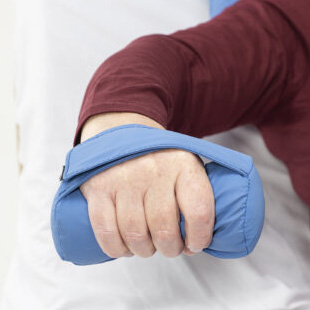
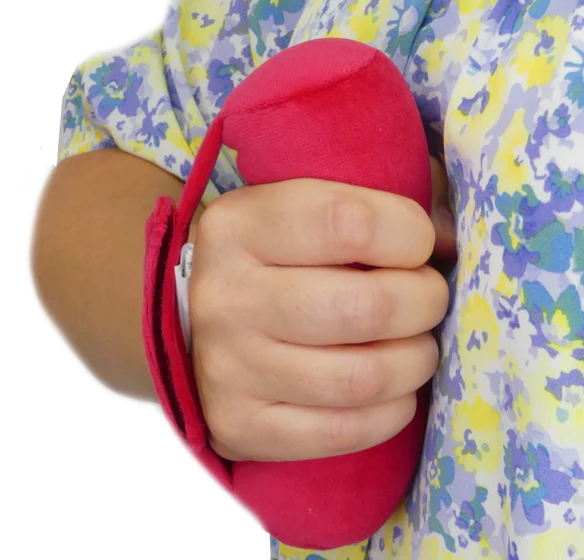
Medoris Hand Splint
Can be used on either left or right hand. Use for those who have moderate to severe contractures.
Soft cylinder shaped to stop hands and fingers closing into the palms and prevents the nails digging into the skin.
Tiny microbeads mould in the palm of the hand, making it soft to touch and easy to position. They distribute weight evenly under pressure, giving appropriate resistance when squeezed.
They don't hold the hand's heat which can lead to overheating. Instead, the beads allow for an even airflow, resulting in a much cooler
Velcro strap for easy fastening and comes in two sizes:
- Standard: Length 10 cm (4"), Diameter 4 cm (1.5").
- Large: Length 15 cm (5.9"), Diameter 5 cm (1.9").
To gradually build up wearing of splint.
How to obtain: Healthcare professionals can order via Millbrook Healthcare.
Sensi-Care Wand
Wiping over the palm of the hand with a Sensi-Care Wand may prevent the palm becoming moist when contracted.
Resources
Download our complete hand contractures resource pack:
Resource 1 - Hand contractures
File size: 261 KB
Resource 2 - Hand contracture hygiene principles
File size: 174 KB
Resource 3 - Pain relief for hand contractures
File size: 217 KB
Resource 4 - Hand contracture presentation and management by severity
Resource 5 - Hand contracture assessment
File size: 396 KB
Resource 6 - Cribsheet for hand contracture assessment form
File size: 190 KB
Resource 7 - Hand contracture decision tool
File size: 145 KB
Resource 8 - Interventions for hand contractures
File size: 284 KB
Resource 9 - Medoris hand splint template
File size: 251 KB
Resource 10 - DermisPlus template
File size: 244 KB
Resource 11 - PCM template
File size: 230 KB
Resource 12 - Sheepskin style palm protector template
File size: 200 KB
Resource 13 - Fingernail care
File size: 235 KB
Related services
Care Home Support Team
Support and training for care home staff to improve the wellbeing of residents.
Care Home Support Team: Go to service