

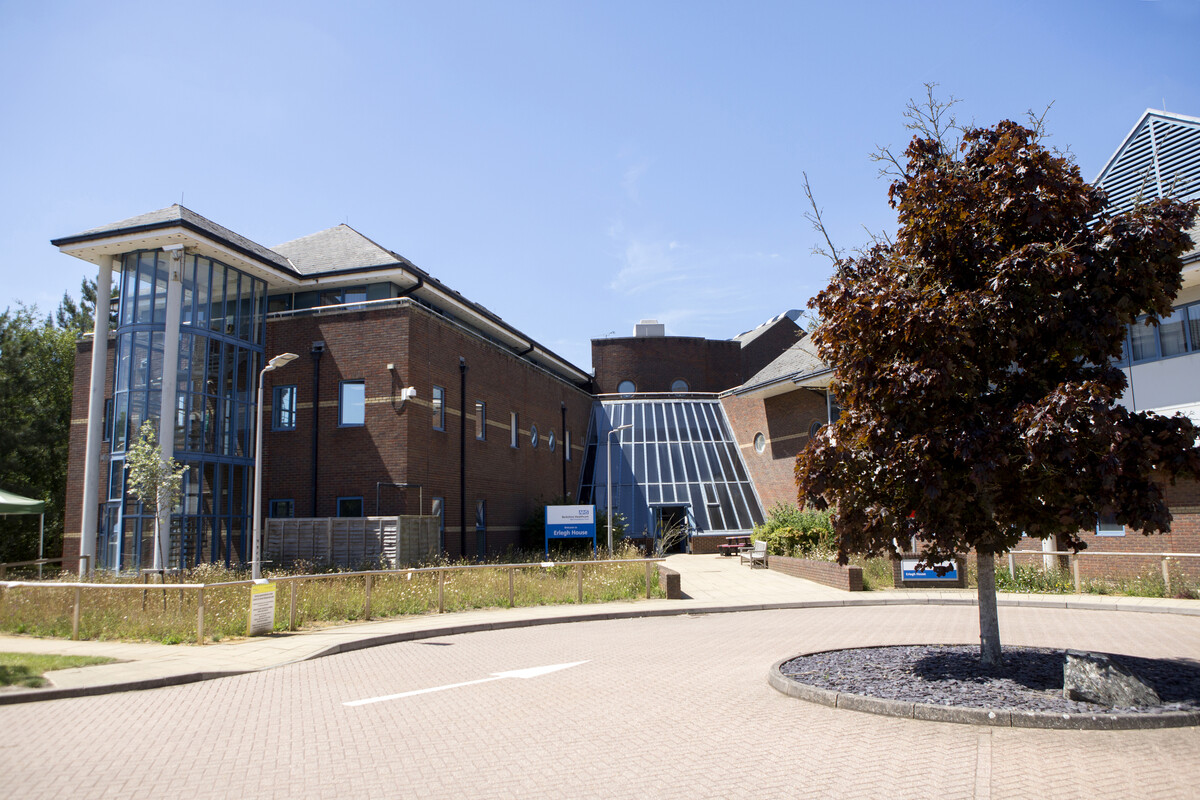
Accessibility information
We have a number of facilities available at Erlegh House. For further information about this location, view a detailed accessibility guide created by AccessAble, which includes information about entrances, facilities, and parking, to help you plan your visit.
Onsite parking including blue badge/accessible parking bays, designated drop-off point
Ramped/sloped access and/or manual doors
Step free standard toilet, accessible toilet, ambulant toilet, gender inclusive toilet
Baby change facilities
Assistive listening, hearing loop
Frequently asked questions
Are there service specific opening times?
Location and service specific opening times may differ. Please contact the service directly to check opening times.
Is there car parking?
We have free patient parking on site. In most cases, patients will be sent a permit with their appointment letter. Alternatively, you can request one from the main reception on arrival.
We can also help you with
How do I request an interpreter?
We can provide language translation and interpretation support.
Tell our staff which language you prefer to use, and we will make sure the right communication support is in place for your assessment and treatment. Please let us know as early as possible so we can ensure the appropriate translation or interpreting support is available.
We offer a range of professional services to ensure everyone can understand and be understood:
- Telephone interpreting
- Video remote interpreting (VRI)
- Face‑to‑face interpreting
- Written translation
- British Sign Language (BSL) interpreting
How can I get information in an accessible format?
Anyone with a disability, impairment, or sensory loss has the right to receive information in a format that meets their needs.
Under the Accessible Information Standard (AIS) – a legal requirement for all health and adult social care providers – we must ensure that people who use our services, including carers and families, can understand the information we provide and communicate effectively with us.
We can offer information in a range of accessible formats, including:
- British Sign Language (BSL)
- Large print
- Braille
- Audio
- Easy read
- Text message
- Face‑to‑face support with a carer or advocate present
If you need information in any of these formats, please tell a member of our team and we will make sure your communication needs are met.
Getting here
By car
-
Route: Follow signs for the University of Reading. Enter the campus through the Earley Gate entrance on Whiteknights Road.
-
Parking: We have free patient parking on site. In most cases, patients will be sent a permit with their appointment letter. Alternatively, you can request one from the main reception on arrival.
-
Route planner: Use the AA Route Planner for tailored driving directions.
By bus
- Nearest bus stop: Erlegh Gate
- Routes:
From Reading Station/Town Centre:
Whiteknight 20 – Direct to Whiteknights Campus (Earley Gate), every 10–15 mins during term time.
Claret 21 – Also runs from Reading Station to Whiteknights Campus.
Other routes: Leopard 3, Buzz 9, Ruby 10 also serve nearby stops like Christchurch Green.
Timetables
By train
-
Nearest station: Reading Railway Station (about 2 miles from campus).
-
Connection: From the station, take a local bus or use a taxi.
Booking services

Patients and visitor information
Find out more about visiting our locations as an outpatient, inpatient or visitor.
Learn more