

Advice and resources : The journey to school
How can we help
Dressing skills
Help your child with dressing by breaking the task down into little steps.
Learn moreSwitching tasks
Transitioning is when a person moves from one task to another or from one room to another.
Learn moreHow can we help
Dressing skills
Help your child with dressing by breaking the task down into little steps.
Learn moreSwitching tasks
Transitioning is when a person moves from one task to another or from one room to another.
Learn moreRoadmaps
The following information is also available as a PDF information sheet that you can download.
Journey To School Guide
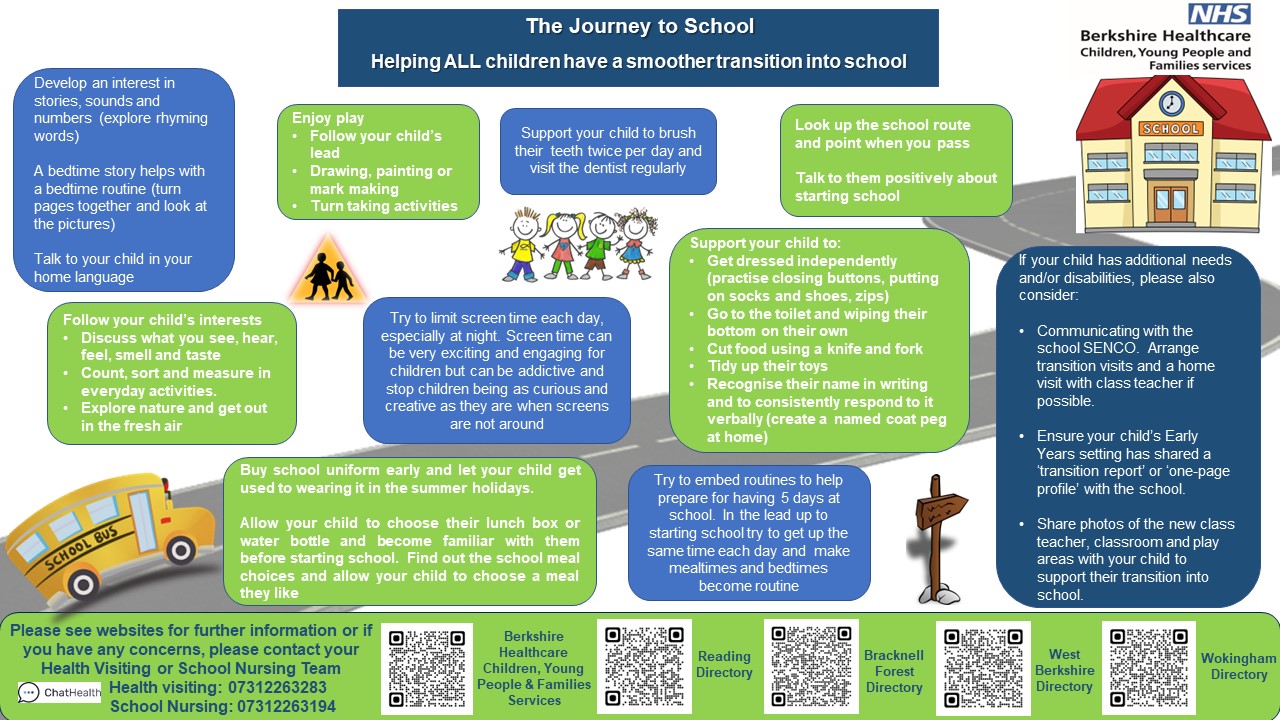
File size: 308 KB
The Journey To School Roadmap & Checklist
File size: 520 KB
Develop independence
Support your child to:
- get dressed independently (practise closing buttons, putting on socks and shoes, doing up zips, etc.).
- go to the toilet and wipe their bottom on their own.
- cut food using a knife and fork.
- tidy up their toys.
- recognise their name in writing (create a named coat peg at home) and to consistently respond to it verbally.
Prepare them for the routines
- In the lead up to starting school, try to get up at the same time each day, and have meals and bedtime at regular times.
- Support your child to brush their teeth twice per day and visit the dentist regularly.
- Look up and travel the school route and point when you pass. Talk to them positively about starting school.
- Find out the school meal choices and allow your child to choose a meal they like.
- Buy school uniform early and let your child get used to wearing it in the summer holidays.
- Allow your child to choose their lunch box or water bottle and become familiar with them before starting school.
Develop their interest in stories, words, sounds, and numbers
- Explore rhyming words.
- Include a bedtime story in their routine (turn pages together and look at the pictures).
- Talk to your child in your home language.
- Follow your child’s interests.
- Discuss what you see, hear, feel, smell, and taste.
- Count, sort, and measure in everyday activities.
Practice creativity and sharing
Follow your child’s lead and do activities they enjoy, such as drawing, painting, or mark-making, but also prepare them for the classroom by practising turn-taking.
Try to limit screen time each day, especially at night. Screen time can be very exciting and engaging for children but can be addictive and stop children being as curious and creative as they are when screens are not around. Explore nature and get out in the fresh air.
Supporting a child with additional needs and/or disabilities
Consider doing the following to support your child’s transition into school:
- communicate with the school Special Educational Needs Co-ordinator (SENCO) and arrange transition visits and a home visit with class teacher if possible.
- show your child photos of the new class teacher, classroom, and play areas.
- ensure your child’s Early Years setting has shared a ‘transition report’ or ‘one-page profile’ with the school.
Further information
If you have any concerns, please contact your Health Visiting or School Nursing Team.
School Nursing Service
- Children & young people
Nurses with specialist public health qualifications who support children at state, free, and academy schools, or home schooled.
School Nursing Service: Go to serviceHealth Visiting Service
- Children & young people
Support for families with children under 5, including screening tests, developmental reviews, immunisations, and parenting advice.
Health Visiting Service: Go to serviceLocal authority support
East Berkshire
Check your local authority's directory to find further support for your child.
Local authority support
West Berkshire
Check your local authority's directory to find further support for your child.